
How jewelers describe jewelry eras
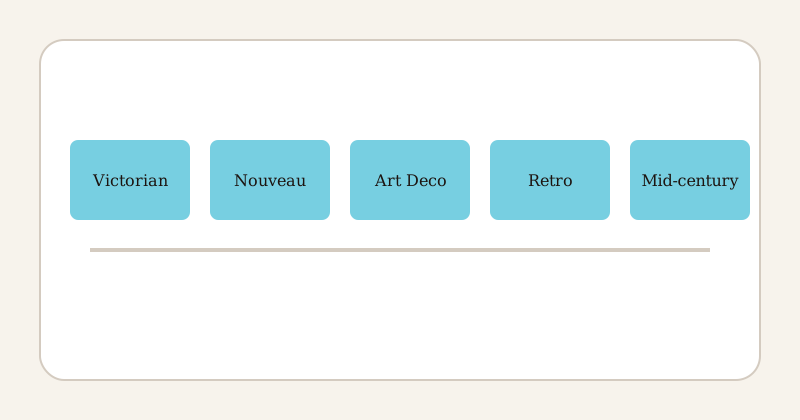
A jewelry era is a style period, not a price list. Names such as Victorian, Art Deco, and mid-century describe typical design, materials, and construction from a span of years. An era label helps you talk about a piece. It does not, by itself, prove age or value.
Last updated September 5, 2026
Key takeaways
- Era names describe style and typical construction, not a payout.
- Victorian, Edwardian, Art Nouveau, Art Deco, Retro, and mid-century are common Western labels.
- A later piece can copy an earlier style.
- Reproductions and repairs can mix parts from more than one period.
Why jewelry is grouped by era
Dealers, appraisers, and collectors use era names as a shared vocabulary. The labels grew around Western fashion and manufacturing. They are a teaching tool. A piece can sit on a border between two labels, or copy an older look decades later.
Common Western jewelry eras
Victorian and Edwardian
Victorian usually covers 1837 to 1901. Motifs, mourning jewelry, and changing cutting styles appear across that long span. Edwardian, roughly the first years of the twentieth century into the 1910s, is often lighter in look, with platinum and lace-like metalwork on surviving pieces.
Art Nouveau and Art Deco
Art Nouveau, around the 1890s to 1910s, favors curved lines, enamel, and nature motifs. Art Deco, strongest in the 1920s and 1930s, favors geometry, contrast, and clean lines. The two are easy to confuse in photographs. Construction and motif usually separate them better than a single stone shape.
Retro and mid-century
Retro, often tied to the 1940s, can show larger volumes in gold and bold clips. Mid-century covers the postwar decades and a wide range of workshop and costume work. Costume and fashion jewelry from these years can still carry maker marks.
Era is not the same as value
Age does not automatically raise or lower what a piece is worth to a buyer. Metal, stones, condition, completeness, and whether the piece is a later copy all matter. A well-made later piece can be easier to wear than a damaged older one. An estate lot is often a mix, not a single textbook era.
What we look for
When a collection arrives, we sort pieces at the counter and note construction, marks, and condition. An era label, if it is clear, is part of the itemized explanation. A mixed lot can include more than one period. We do not assign an era to force a story.
Related visits
Next step: more Learn articles, or contact the shop.